Client
Excavaite
Year
2024
Status
Live
Skills
AI Native Product design
UX research
Interaction design
Design system
Overview
Excavaite is a zero-to-one AI-assisted patent management platform for enterprises that can't track, collaborate on, or research their IP at scale. Built for three roles: Innovator, Legal Counsel, C-suite, sharing one application, not three separate tools.
Problem statement
Enterprises generate patentable ideas faster than Legal Counsel can track, evaluate, or defend them, with no shared system coordinating inventors, reviewers, and the C-suite.
Legal Counsel carries the structural load, at real scale
A stage-by-stage involvement matrix (8 lifecycle stages × 3 roles) showed Legal Counsel at High load across 5 of 6 stages. No other role came close
Real practitioner accounts confirmed the scale of that load: a sole in-house patent counsel managing ~50 granted patents and ~100 pending applications does no drafting or prosecution in-house at all. Every application moves through outside law firms, 50–80 filed per year, with one internal agent coordinating that handoff. No shared evaluative structure exists across it.

The market is large, fast-growing, and still solving the wrong layer
A market of $12B, growing this fast, sits on top of a category where intangible assets already make up nearly 90% of the S&P 500's value. Yet of the 8 AI-augmented IP tools profiled (Clarivate, Anaqua, Questel, Patsnap, AI Samurai, IPlytics, IP Copilot, Amplified), 0 address the coordination load identified above. All 8 compete on the same layer: search depth, landscape mapping, portfolio benchmarking

Users are explicitly rejecting feature bloat, not asking for more of it
The same in-house counsel persona had an explicit out-of-scope list: docketing, IDS prep, and drafting tools, all "outside counsel's purview," not wanted in the product at all. The market's incumbents are mostly building toward law firms, not toward the lean in-house teams actually doing the coordination work.

The patent troll threat is large enough to design around, not just acknowledge
Every competitor we studied solved the coordination problem with more dashboards and more search depth. None of them touched it directly.
One filer brought 179 infringement suits in a single year. The market's answer was still more dashboards.
60%
Share of patent litigation driven by NPEs
50%
Share of all suits brought by PAEs specifically
70%
District court litigation tied to high-tech
95% (vs. 27% for non-NPEs)
NPE targeting rate, high-tech companies
179 (Cedar Lane Technologies)
Top single filer, infringement suits in one year
Build one shared system, not three tools. Three roles, one application, differentiated by access and data scope, not by separate codebases.
Compete on trust architecture, not analytics depth. The market's gap wasn't search quality. It was coordination and confidence in AI output.
Score for green innovation. A factor 0 of 8 competitors account for, added directly to the evaluative core.
Name the threat, not just the filer. Filer Classification (Known Competitor / Patent Troll-NPE-Aggregator / Government / Law Firm) is a direct response to the litigation data above. A 60% NPE-driven threat landscape where a single filer can bring 179 suits in a year isn't a hypothetical risk category; it's a load-bearing feature requirement.
Build lean, not law-firm-shaped. The in-house counsel persona's explicit out-of-scope list (docketing, IDS prep, drafting) matches the product's own scope decisions: built for the team doing the coordination work, not for a law firm's full back office.
What carried over, and why
The scoring core (uniqueness, business relevance, industry relevance, green-innovation) and the Abstraction/permissions logic were never tied to Copilot's generation step. They were the evaluative mechanism itself, so nothing had to be rebuilt for Screener.
The three scores stay separate rather than one composite number, because a high-uniqueness, low-business-relevance disclosure is a different business call than the reverse. Collapsing them would hide that judgment, not simplify it.
The form filled and disclosure generated with the report assessment
In-document collaboration, as one continuous loop
Highlight text, get an AI-suggested edit inline. Accept it, refine it, or write your own. Nothing applies automatically.
Every edit creates a new version. The prior draft stays in history, never silently overwritten.
Tagging routes a document to the right reviewer, instead of relying on someone noticing it in a shared queue.
Comments are the constant, present on every reviewable surface.
External reviewers join as a separate, role-tagged group (Invited Members), distinct from internal Team Members. Outside counsel gets looped in without full internal access.
Invite team members for collaboration and see how the highlight and ask AI works
The litigation strategy that didn't survive the cut
The patent-troll threat was large enough to design around directly: 60% of litigation NPE-driven, a single filer bringing 179 suits in one year. Filer Classification, inside Assertion Response, tagged a filer as Known Competitor, Patent Troll-NPE-Aggregator, Government, or Law Firm, and changed the defensive strategy shown accordingly.
Real and evidence-backed, and honestly one of the five flows cut in the pivot. It didn't carry forward into what the enterprise clients use today.

Assertion and Response screen
Assertion Response, while it existed: comparison, not generation
The one flow that wasn't drafting something new. It held the asserting party's claim language against the product or document in question, side by side, in an editable comparison table, so legal counsel could adjust the comparison directly rather than accept an AI-generated verdict.
Prior art search, as its own tool
A standalone Patent Search tool, separate from Copilot's lighter embedded search. Results return an AI-generated summary, claim count, and citation count per entry, with Find Prior Art and Search Similar as direct actions.


Prior art search screen
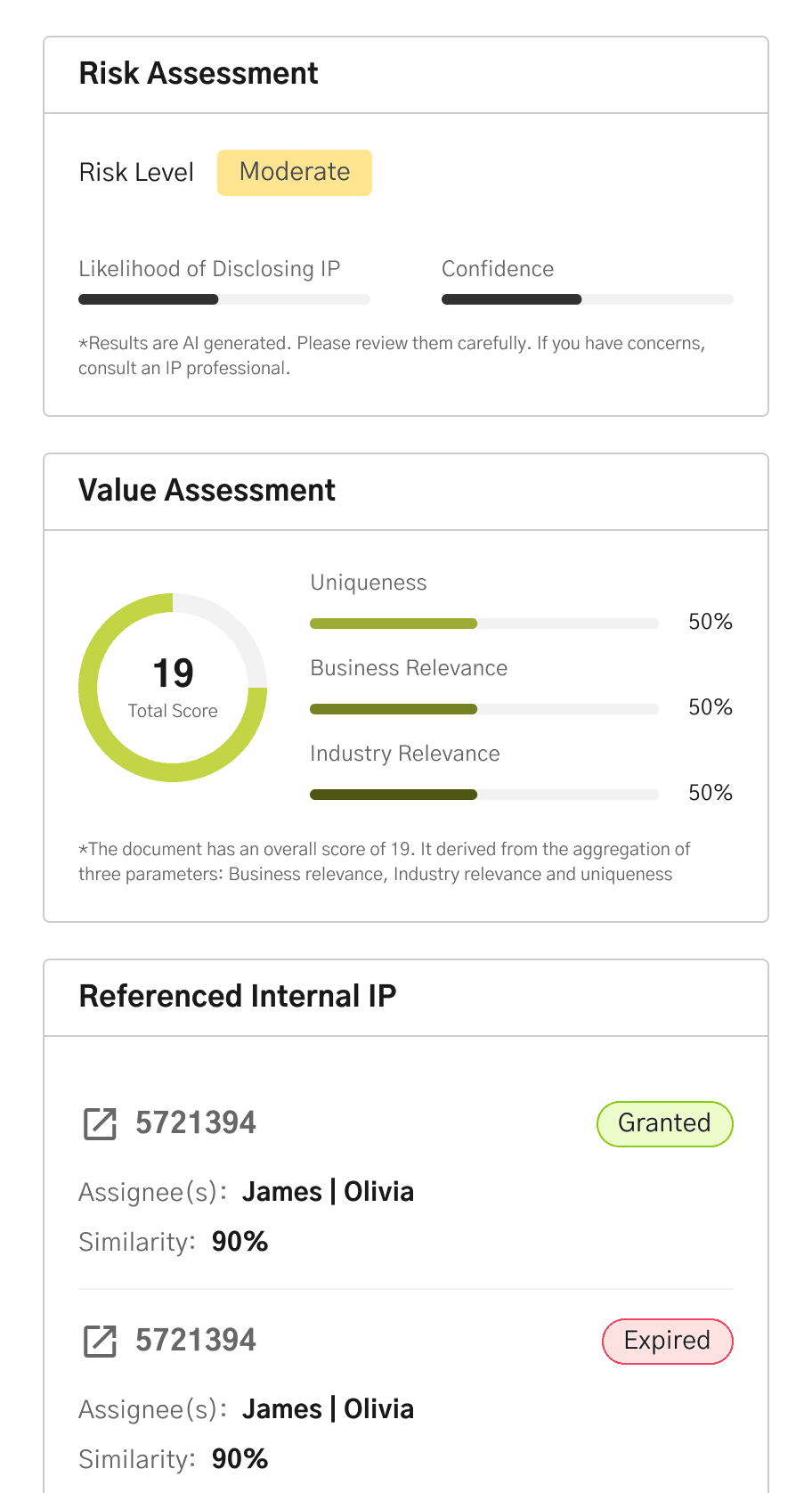
This is a product where AI is a core feature, not the whole premise. The design problem was control and explainability, not novelty.
What's built in, with proof:
Persistent disclaimer on every AI output: "Results are AI generated, consult an IP professional"
Editable draft, never accept/reject only
"Likeliness" language, never false certainty
Cited external patents behind every score, independently checkable
Architecture-level proof, not just UI copy:
TLS 1.2+ encryption on every outbound AI service call
Contractual prohibition on training any model on customer content, no exceptions
Deny-by-default egress: only approved AI endpoints reachable
Swappable multi-vendor LLM layer (OpenAI / Anthropic / Gemini-class providers) rather than one proprietary dependency



Built broad, chasing a USP
Six flows across three personas felt like differentiation at the time, not risk. A wide, comprehensive platform was the intended competitive edge against incumbents, not a problem to be caught early.
Challenges from the client
No real scrutiny. Nearly everything proposed got approved, almost no friction.
Onboarding cut for budget, not for failing a test.
No post-launch testing or structured feedback, despite repeated requests. Adoption stayed limited, and the trust mechanisms above went unobserved against a real, tested user.
Hard to find new buyers. A year passed before the two enterprise clients signed. Most prospects in between didn't convert.
"If nothing I propose ever gets pushed back on, that's a signal to slow down, not speed up. Either I'm right every time, or no one's checking."
The pivot
Two enterprise clients signed on one condition: one flow, Screener, nothing else. The bloat wasn't solved by designing our way out of it. It was solved when the market made that decision for us, and the part doing the real thinking didn't need rebuilding when everything else was stripped away.
Sentry flow
A feature list is negotiable. Whether the interaction pattern underneath it was ever one coherent system, reused on purpose and not duplicated by accident, is what determines whether it survives a scope cut you didn't choose.
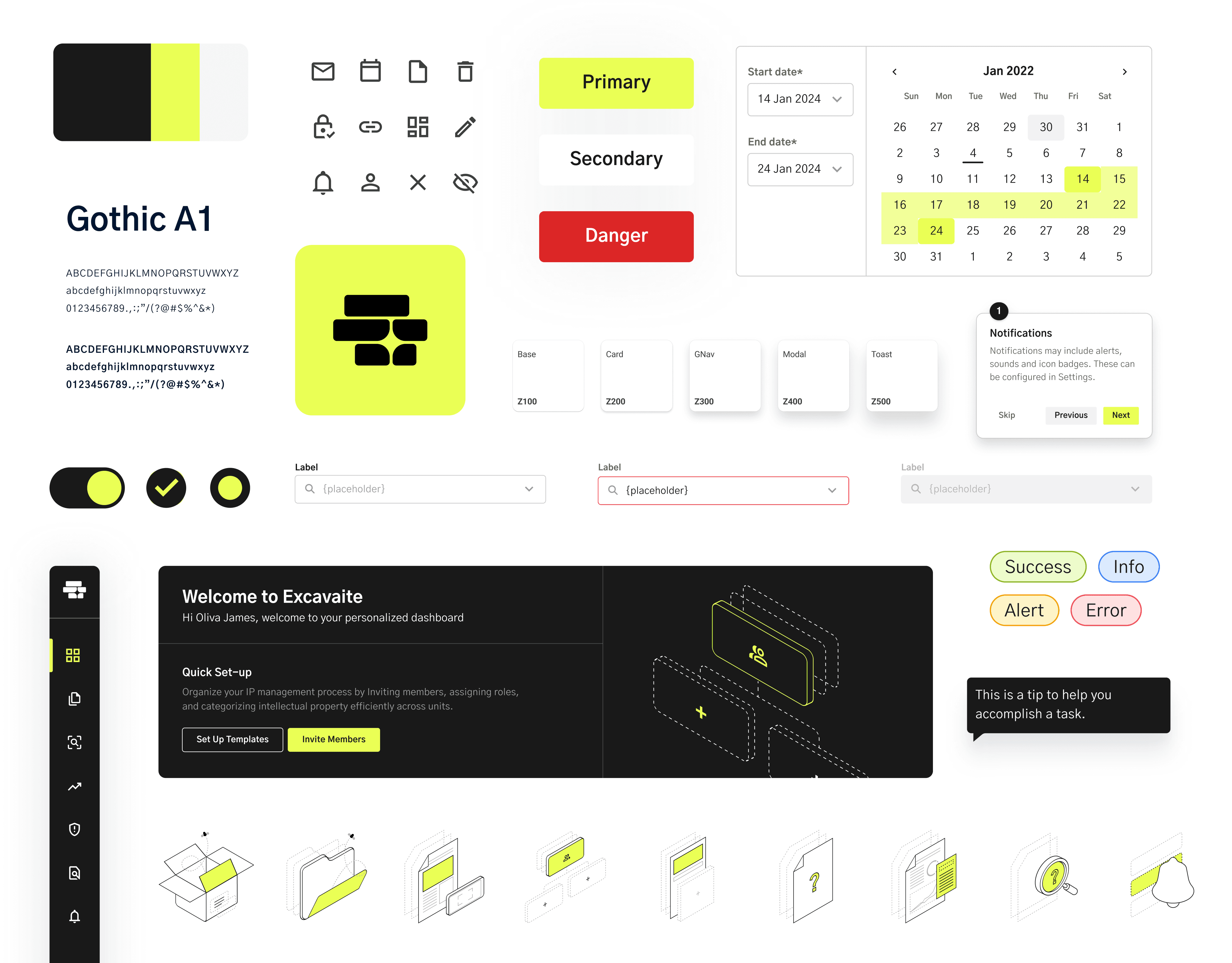

Design system building with white label solution strategy